Tuesday, April 8, 2014

To Control or Not to Control: Travis Bickle’s Burden in Taxi Driver

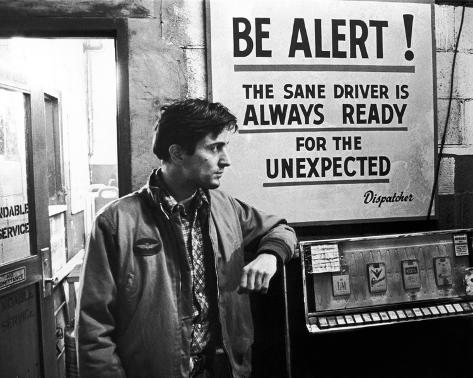
        The 1976 film Taxi Driver by director Martin Scorsese centers around the mentally deteriorating Travis Bickle and his attempt to control the city and the people around him. Travis’ conflict with control is the result of struggling between self-direction and controlling personal fate and a predetermined life that cannot be escaped. This issue with control is vital to the film, because where most people would see Travis as a war-torn, antihero, I see Travis as the product of overbearing forces of control and desire to design his own fate. It is his lack of control and discovery of this deficiency that drives Travis to the downhill spiral of violence and break from reality. Relating Travis to other characters within the film such as the Wizard and Iris, who provide Travis with insight on their own ideas of destiny and control over it, I will better construct the proposed idea of Travis’ burden as the tension between control of one’s fate and predetermined destiny/fate.
            The film follows Travis’ as he moves towards controlled destiny while he attempts to improve his life with getting a job as a taxi driver, finding a girl, and “cleaning up” the city, but when things don’t go as planned, Travis slips into a dark realization that things are out of his hands. Travis wishes to supplement his loneliness and lack of direction by redirecting his life for what he believes is a positive, but after Betsy rejects his advances and Iris ignores his efforts to rescue her, Travis flips the switch and buckles up for a ride of negativity. The scene that captures the change of direction in both Travis and the film itself starts at [1:32:15-1:33:56]. In the shooting script of Taxi Driver, Paul Schrader titles this section “God’s Lonely Man,” which directly reflects Travis’ self-identification as the victim of predestinated fate.
            The scene opens with the sound of shots and immediately the audience is introduced to Travis at the firing range. The scene then moves into Travis’ apartment where we find Travis writing a note and attaching money to the message within the note. A close-up indicates that the letter is to Iris and the money is supposed to be enough for her trip. The letter is dismal and desperate with the message:
            “Dear Iris,
            This money should be enough for your trip. By the time you read this I will be dead.
            Travis.”
A voiceover then chimes in as Travis claims “My whole life has pointed in one direction. I see now. There never has been any choice for me.” Following Travis burning flowers in his apartment and writing his last entry, the camera moves outside to Palantine’s campaign event. By showing the crowd of people and Palantine’s arrival, the film foreshadows direction Travis is about to take. It is clear that Travis believes that since he cannot control his own fate, he has only one choice: kill presidential candidate Charles Palantine and then himself. Following the scene, Travis is seen placing the envelope with Iris’ letter and money in the mailbox as he walks through his visibly deteriorating apartment building. I believe the apartment building, Travis’ home, correlates to Travis’ own deterioration and breakdown.

            Travis’ need to control his life and the people and things associated with him ultimately becomes the trigger for the dissolution of his character and mental state. It is through the lack of control of his fate that Travis’ violent nature and motives surfaces, as does the films own violent subtext becomes evident. I believe that without the understanding of Travis’ realization, as irrational as it may be, the film’s final moments would not hold the weight that they do and Travis will appear as the antihero, “vigilante” that many viewers have come to identify him as, rather than the result of slipping control.

Sunday, April 6, 2014

The Crazy Daisy: Sexuality and Pull My Daisy

Robert Frank and Alfred Leslie's 1959 short film Pull My Daisy captures the Beat Generation through its spontaneous shots, improvised narration, and the inclusion of various artists, writers, and performers. In a particularly conservative time in American history, Pull My Daisy speaks to the many issues that were opposed or swept under the rug during the 50s-60s, especially questions of sexuality.

One explicit example of Pull My Daisy's comment on sexuality can be found in the opening title sequence. Prior to the film's opening, there is a title card for the production company. That title card reads: "A G-String Enterprise. Copyright 1959. By G-String Enterprises." G-String, huh? A skillful way to introduce the sexually driven force behind the film's narrative by naming the production company (the way the film is made) after the type of underwear often associated with sex appeal and scandalous performances, such as burlesque and exotic dancing. 

Following the title card, there are shots that pan across the various areas that introduce the loft in which the film takes place, but it is the lyrics of the song that plays during the sequence that introduces the film's position on sexuality strongly.

The jazz tune that was produced for the film has lyrics that were written by Jack Kerouac,who also narrates the film. The lyrics heard are: 
                              "Pull my daisy
                               Tip my cup
                               All my doors are open
                               Cut my thoughts for coconuts
                               All my eggs are broken
                               Hop my heart on
                               Harp my height
                               Seraphs hold me steady
                               Hip my angel
                               Hype my light
                               Lay it on the needy."

Seems relatively mild right? Well through research, I found the complete lyrics for the song, and it is explicitly expressing sexuality. There are various lines throughout the song that suggest pleasure and climaxing, for example: "Bone my shadow, Dove my dream, Start my halo bleeding. Milk my mind and make me cream. Drink me when you`re ready." It is evident that this is referencing sex and the explicit description of sexual intercourse from the woman's perspective.

Jack Kerouac's influence on the film extends further than just writing the lyrics to the catchy song in the beginning. He serves as one of the writers of the poem in which the title of the film gets its name from and his play "The Beat Generation", influence Robert Frank and Alfred Leslie to make the film. Kerouac's major influence comes from his position as the narrator of the film. The narration was improvised in a sound room following the film. The chaotic nature of Kerouac's rambling and seemingly unsynchronized dialogue is fundamental for the cinema of the Beat Generation. However, it is the various overlapping of dialogue with images that sexualize his words. There a multiple shots of mouths. Mouths speaking, drinking, blowing on instruments, smoking, etc. These shots may correlate to the idea of oral fixations which are often linked to infant and childhood sexuality (Freud). Also, these shots are often matched or followed by the close-ups of legs and hands interacting with the legs/lap regions. An example can be seen at [11:15-11:20] and again at [13:19-13:26] where conversation is occurring and sexual tension is very present within the scene. The latter of the two is paired with the narration ""It's a kinda strange and interesting evening", says the Bishop."

The film also hints at homosexuality with the close proximity shots of the men often sitting together or on one another, laying together, and touching one another.Referencing back to oral fixations and its link to sexuality, I find it interesting that there are various close-ups that accompany the men playing instruments that require them to blow into the mouthpiece or onto phallic shaped instruments such as a flute. This is another characteristic of the Beat Generation and I believe correlates with the sexual exploration through the cinema that Frank and Leslie wanted to accomplish.


Pull My Daisy explores sexuality in various ways, although not always explicitly displayed on the screen. The writers and other Beat Generation participants worked to produce a film that is traditional in aesthetics and formal techniques, but unorthodox in content and appeal. The various issues of the 50s-60s that were challenged by the members of the Beat Generation are the foundation for Pull My Daisy, and can be justified by the work involved in making the film.

Friday, April 4, 2014

"If You're Yourself, You Won't Get Hurt"


Cassavetes' 1959 film Shadows documents the lives between various New Yorkers living through different occupations, economic status, race, ambitions, etc. The nature of the film and it's production lends to the emergence of experimental cinema and art films. The idea of art is prevalent throughout the entire film and that will be the main focus of this blog entry too.

In the scene [26:24-28:00], the camera introduces the audience to a party. Here we see Lelia discussing how she never intended to be a writer and that the position was thrusted upon her by David. This introduction to Lelia's objection to the idea of being a writer, especially for a profession, is key for many of the elements that influence and drive Shadows. For example, this film comes out of the Beat Generation which surrounds the rise in writers who were interested in rejecting and dismissing societal standards, new styles, experiementation with drugs, sexuality, and various arts, and the interest in the displays of human condition in the world. The scene further ventures into this world of beat writers and intellectuals as we see a woman discussing existentialism with another out of the frame. Lelia's position in this scene and in the party is complicated, because there is an artistic spirit and drive in her that draws her to be surrounded by the elements of the party, and of the culture, yet she cannot be receptive to the forceful nature of commercialized, institutional, societal pressures from the people around her. Her rejection is an attempt to protect herself from being hurt by the masks people wear, the falsity of relationships and ideals, and the idea of "selling out."


Relating Lelia's attitude and response to David's pressure to be a professional writer to the overall theme of shadows and shadowing, it is evident that Lelia's position in society or in the open, art circuit she is attracted to is affected by her decision to either dismiss the standards of society and struggle to find her place or succumb and follow the rules which risks losing the passion or drive. Living in the shadows of other successful people, her friends, and her brothers, I think Lelia searches for a way to be seen, which ultimately leads to giving her self over to Tony in an effort to find love. Even then, a shadow is cast on her when Tony reacts to the reveal that she is partially black, and she is immediately disgusting to him. Her race becomes an issue and another factor that pushes her in the background of life's show, when everyone else seems to be in the spotlight. Both Lelia and her brothers find themselves dealing with the complexity of late-1950s, Beat Generation, New York where being yourself doesn't provide the protection that Lelia suggests towards the end of the scene.

Friday, March 28, 2014

The Trouble with Travis


Throughout the film Taxi Driver, the audience is introduced to the troubles of main character Travis Bickle. Troubles that include insomnia, disgust with the people who occupy New York City, troubles with making and maintaining relationships, and troubles with himself, drive the film to the ultimate breaking point when Travis kills the pimps who employ a 12 year old named Iris that Travis is interested in "helping." The scene that I am interested in investigating begins at [20:23-22:23] when Travis decides to enter Palantine's campaign office to ask Betsy out on a date.

The scene begins when Travis approaches the desk that Betsy is sitting at. Their conversation is initiated by Travis' proposal to become a volunteer for the office. Complications in the fluidity of their conversation arise when Travis is unable to produce solid answers to the questions Betsy asks him about Palantine's policy and campaign. However, for the first time Travis seems to spark a mild confidence as he casually brushes off the lack of knowledge and supplies supportive words and interest in the presidential candidate. As Betsy informs Travis of the hours required as a volunteer, Travis interrupts and tells her that he unfortunately works as a taxi driver at night. As Travis reveals his job, Betsy moves away from him and adjusts her posture to appear "'proper."

It is in this moment that Travis' position in society aligns with scum he is disgusted with, and Betsy and the other volunteers at Palantine's office are above him. Travis' attempt to break through the societal barrier between the two different worlds comes through in his approach for a date with Betsy. Something changes. Travis, although persistent, masks his insecurities with a kindness and welcoming gesture that reels Betsy in. Their dialogue shifts when Travis suggest that she could call him a friend if she wanted to. Betsy replies with "Are you gonna be my friend?" with an inviting quality behind her words. 

This scene is significant to the entirety of the film and to the deterioration of Travis' mentality throughout the film, because this is a turning point for Travis. His motivation is to gain Betsy in his life, as a friend or as a potential lover. When she accepts his gesture and they go out on a date later in the film, Travis makes attempts to please her in the ways he feels appropriate. The moments of confident Travis and Betsy, the audience sees Travis cleaned up and in semi-formal attire instead of his casual button downs and military jacket. Travis is also more vocal than he appears in majority of the film, and Travis has a particularly calm and positive nature than his exposed violent one he possesses in the key scenes of Taxi Driver.


I think that Betsy, along with Iris, had the potential to "help" Travis if things went accordingly. As this scene shows, there was a potential good outcome for Travis, but when his control slips from his hands and he realizes that his plans fall through, violence and "revenge" surface and the film that was produced becomes the final product. 

Wednesday, February 26, 2014

The Old Man Came Rolling Home


   Killer of Sheep illustrates the life of a working class, African-American by the name of Stan, who happens to be an employee at the local slaughter house. I chose to delve into a scene from [15:50-18:00] where Stan is shown working at the slaughterhouse.

   Within this scene, Stan appears to be cleaning up the factory like space and finishing up his days work. Throughout the film, the slaughterhouse scenes represent the violent nature of society in the 1960s-1970s, Stan's personal ties to violence through his upbringing, and the blatant violence of slaughtering sheep. Stan's time spent in the slaughterhouse is an avenue for improvement of his life through finances, although his living situation does not change within the film. Yet, the slaughterhouse is a vehicle for the violence that is instilled in Stan; a violence that harbors within him that never seems to surface.

   Following Stan's shift duties, he returns home to his family. At approximately [17:31], the camera pulls from inside the slaughterhouse and moves outside to establish a shot of the building itself. At this time, the chiming in of children singing "This Old Man..." The lyrics of this harmless children's rhyme are key to the scene and the overall picture that is taken for the film:
           
           "This old man, he played one,
             He played knick-knack on my thumb;                        
             With a knick-knack paddywhack,
             Give the dog a bone,
             This old man came rolling home."


    The song is key in understanding Stan's position in his family, at work, and in society. "This old man...," correlates to Stan's age and to the often used terminology for a husband or male lover as "my old man." Stan's move from childhood to adulthood is reflected in the opening scene of the film when he is being reprimanded by his father over a neighborhood fight. By the time we are able to formally meet and watch Stan he is very much an adult, with a wife and children to care for. By placing the children's song at the end of Stan's shift, the audience can grasp Stan's place in the slaughterhouse and in 1970s society by focusing on the line "Give the dog a bone, this old man came rolling home." A dog. Stan and other African Americans surrounding him are subjected to the racial injustice of being compared to by a dog. Dogs roam the streets, dogs are aggressive, dogs are filthy when not taken care of, and more importantly dogs are subjects of ownership. Stan is owned by society. Stan is owned by his father's lessons. Stan is owned by poverty. Stan is owned by the socioeconomic white workplace.


   Stan's struggles with making a name for himself and making a substantial amount of money for his family are accurate portrayals of the society that Charles Burnett aimed to capture. There were hundreds, thousands, millions of characters like Stan in America at the time. Following race riots and civil rights protests, Killer of Sheep strives to capture an audience by association. African American viewers can relate through personal struggle with race in America, stories from relatives who lived during that time, public forums of the news documenting a new horror for members of the Black community almost daily, whereas viewers from other racial identifications, more specifically White/Caucasian viewers, can experience Stan's story through the relationship to their own struggles financially, social discrimination towards women in America, the relationship between being white during a time of racial inequalities, and being associated with the trivial issues that Stan and many others within the film are dealing with.


Friday, February 7, 2014

Love On the Road


In the 1969 film, Easy Rider, the story of two free-spirited friends traveling East on their motorcycles in search for a life better than the ones they are living, the experience of love between the men and their motorcycles can be seen through the various shots and camera angles used throughout the film.

Director Dennis Hopper, who also stars in the film as Billy the Kid, chooses to shoot the motorcycles from various angles to demonstrate their significance in the journey. There is something fascinating about the way the bikes are seen on camera, because there is an element of life brought to them. They are no longer the objects of transportation, but the tool that both brings life to the men and takes it away. The motorcycles are vehicles for mobility and the force to driving the two men towards their dreams, but the relationship established between the drivers and the bikes is stronger than just man and machine.


A love story. Yeah, it sounds crazy, but hear me out. Through the various camera angles, the bike takes on the position of a woman. For example, there is a panning tilt shot of Captain America's bike that we viewed in class, where he is shoving the money into the gas tank, that resembles the shots that were often used to move up on a woman's leg in previous films. This scene, as in many others, places a particular sexual desire on the machine. Also, the idea of Captain America inserting the money into the bike, suggests "penetration" which could be read similarly to a man penetrating a woman, also known as sexual intercourse.Emphasizing this femininity and sexuality of the bike, the men are continuously "riding," which is often a term that relates explicitly to sex.

Although we see both Captain America and Billy the Kid interacting and having social relations with women throughout the film, there is no established relationship or significant other figure present. Except their bikes. The motorcycles are there with them through everything, and become the substitute for a relationship. The care and protection the men put into their bikes takes away from it as a possession and brings light to the fact that it means much more to them than just a bike.


Friday, January 31, 2014

Women In Cinema: From Thelma and Louise to Bridesmaids 


Today in cinema, films are being produced with the aim of pleasing female audiences, yet very few actually have a dynamic cast of women. In 1991, Thelma and Louise put women in cinema on the map. It delivered a "truth" about women that was rarely, if ever, seen on the big screen, and joined in a momentum of powerful women in television, film, politics, etc. In today's films, women look, act, and deal with life differently than they did in 1991 and the camera captures that.

In 2011, a journalist by the name of Raina Lipsitz, wrote a piece for the Atlantic, on this incredible forward motion for women between 1991-1992 and how after twenty years, the film still resonated for the empowerment of the female race after time lapsed. But what Lipsitz mentions about films today, raises some problems in my book. Lipsitz brings up the Bechdel test for measuring a film's treatment of women, and how there are three things that are required in order for a film to pass the test. They are: (1) there must be two women in it, (2) they must talk to each other, (3) and their conversation must consist of something other than a man or men. According to Lipsitz and Bechdel, films following Thelma and Louise have yet to accomplish this; however, if we examine and dissect Thelma and Louise by these standards, the two characters fail to pass the Bechdel test.


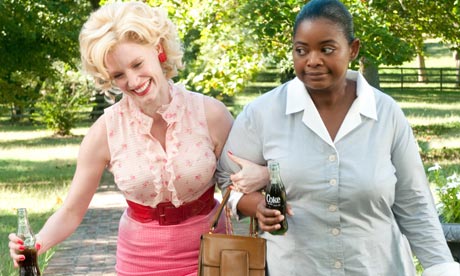
Women in film today may not be defined by the greatness that Thelma and Louise both possessed in 1991, and maybe the characters present in today's film don't redefine or construct a new female gaze for audiences the way Thelma and Louise do, but there is a change. What Thelma and Louise did for female audience members in the early-90s, characters such as Kristen Wiig and Melissa McCarthy in Bridesmaids, Jessica Chastain and Octavia Spencer in the Help, Greta Gerwig and Mickey Sumner in Frances Ha, and many other female duos in cinema today are doing for a new generation of viewers. The Girls-aesthetic, or Millenial perspective, is the main driving force behind much of the dominant sources of media today and with that the depiction of female friendship will change as well. As times change and so do women's rights, the "truth" about women will also change. Problems with men the way that they were for Thelma and Louise do not equate to the problems women face today, and the need to escape from their lives and criminal activity is not the top of the list in today's film. Today strength in women against men or life's troubles, are established through the hardship rather than running from the hardship. The significance of the female friendship, much like that of Thelma and Louise, prevails over the complications men create. That's where the films of today and Thelma and Louise come together. There is no denying the similarities in friendship through these films and how there is often the strong, stable, comforting friend who is whole-heartedly there for the messed up, damaged, subordinate friend through thick and thin. The dimensions of these friendships come from the restrictions that the societal man may place on them, or even just society in its own.
But where Thelma and Louise stray again, comes from how male driven the pressure was. A cast that primarily consisted of men were the opposing forces that ultimately push the pedal, full throttle, and drive the two women off the cliff in the final scene. Today there is so much more than the man driving the forces of women that often never even make it to the metaphorical cliff.

Although Thelma and Louise had its problems in feminism, the stereotyping of women, and its place in the world of cinema in the early-90s, it did provide the opportunity to begin exploring female friendship in a new light. Over the last twenty years or so, the changing in women, their friendships, and their relationships to men are reflected in their changed appearances on camera.

Friday, January 24, 2014

The Ideology of Which Way Home

  There is one segment of the documentary, Which Way Home, that visualizes the ideologies of young immigrant children risking everything in order to make it to America with the dream of being able to provide for their families back home. From 4:04-5:40, the film takes a focus on the statistics of the migrating children and moves with the group of young boys who we follow for majority of the film.

  Here we are introduced to Kevin, who is fourteen years old and mentions how his mother was too poor to afford to support her children, so he dreams of making it to America and providing for her. This received consciousness of many of the children on the same tragic journey is that they must break from the reality of being a child and forcibly adapt into the world of becoming an adult. The uncertainty of their journey can be reflected in the waiting game the boys play on the train tracks as they await a train that will be heading on a track that could potentially lead them to the United States. Before the scene ends, Kevin is scene speaking to his mother on the phone and informing her of where he is located. The vulnerability suggests the youth that all of the children possess.

 Speaking to the ideology of illegal immigration of children from poverished South American countries, the socialization of the young boys in these families leaving home and fighting against the odds of surviving the dangerous travels, has become the main source of reasoning and justification as to why these young men and women are subjected to lending to the notion of creating an ideology. It becomes an issue when it is recognized as a socially constructed problem where at a certain age these children feel it is necessary to take the responsibility of providing for their families by migrating to America. Children ranging from the ages of 10-15, pack up and leave home, sometimes never addressing their departure to their family. For example, when Kevin contacts his mother on the phone at the end of the scene I chose, she has an element of surprise in voice when he mentions his location. There are other children on the journey who never told their parents and just left. The scary realization that most of these children are detained, kidnapped by smugglers, or unfortunate enough to die, emphasizes how unsettling of an ideology Which Way Home depicts.

  The concept of ideologies as a “this is what we do and how we do it” mentality, parallels with the mentalities of the migrants featured in all three movies we viewed so far. Whether they are escaping crime, running from fear, searching for hope, or planning on creating a better life for their family and themselves in another country, each face of the travelling characters from Eddie to Willy to Kevin to Sayra and Sally, become representative of an increasingly heartbreaking ideology forming all over the world where the children of the future have to grow up a little earlier than expected.

Friday, January 17, 2014

Sin Nombre

    Reviewing the film Sin Nombre for this course, I started to see the film in a different light than I had previously. There was an element to each character that I had not recognized before and their significance to the film grew, whether they were present for a short duration or not. For instance, the scene that I chose to focus on this week occurs towards the middle of the film when Lil Mago kills Martha Marlen after she rejects his sexual advances.
    In this scene, the complexity of El Casper's character is visibly displayed through his emotional breakdown when Lil Mago informs him that the devil took Martha Marlen. In an effort to remain loyal to both the Mara Salvaturcha gang he is a member of and to his deceased girlfriend, El Casper begins to show a tether of emotions that parallels the tether between youth and adulthood. Throughout the entire film El Casper is put into positions and scenarios that require him to engage in things that strip away his ability to live as a teenager. Murder, theft, and a life of crime place adult responsibilities onto El Casper, or Willy as he identifies with outside of his gang. Yet, when he discovers that Marth Marlen has been murdered, he retreats to responding with emotions that remove him from this falsified adult persona he lives.
    Although this scene is reflective of the character dynamics between Lil Mago, Martha Marlen, and El Casper, it's key in understanding the other characters of the film and the various elements each possess. For example, Smiley mirrors the struggle between child and adult that El Casper goes through, by dealing with initiation into the gang and taking on the responsibilities of murder. In Smiley's character structure, the introduction of his younger, playground friends emphasizes just how young he really is.
    Age typically directs the behaviors and mentalities of individuals as the development of cognition and identity pair with the various stages of maturation. However, Sin Nombre proves that the varying degrees of growing up are conflicted with the tragic reality of a membership in a violent gang such as the Mara Salvaturcha. Instead of playing with his friends on the jungle gym, Smiley is showing off a gun he intends to kill El Casper with. Rather than enjoy the time spent with his girlfriend and express the proper mourning of her death, Willy, is forced to live within the dark identity he embodies when he is El Casper. The internal tether each character harbors creates an on-screen demonstration of the destructive elements that arise when they are fighting with who they are and who they are expected to be.
   I think that Sin Nombre explores the tensions discussed in my blog in an excellent way, yet I wish there would have been more opportunities for each character to spend time with the other self away from the crime or hardships that life presents to each individual character. From El Casper to Lil Mago, Smiley to Sayra, El Sol to Marth Marlen, created for Sin Nombre deal with a tether, whether it is with youth, relationships, poverty, traveling, escaping death, sexuality, or being a part of something at the expense of themselves.